
Categories
Daily Post English Politics

Phalon-Sawaw Democratic Party (PSDP) talks about its policy, stance and work procedures

Daw Naw Yuzana Wah, Vice-Chairperson of the Phalon-Sawaw Democratic Party (PSDP), presented the policy, stance, and work procedures of her party on radio and television on the evening of 29 October.
The full text of the presentation is as follows: —

I sincerely wish that all monks, indigenous peoples, and citizens across the entire country of Myanmar may enjoy health and prosperity, remain safe from all dangers, and be protected from all calamities.
Our Phalon-Sawaw Democratic Party will uphold human and social rights. We will not act unjustly or arbitrarily, and we will respect and value human dignity. We will not engage in cruelty or violence and will seek solutions through peaceful means. Every individual shall have the freedom to express, the freedom to believe and worship, and the freedom to earn a living. People shall be free from fear, intimidation, and deprivation. We hereby declare to all voters of the state that we are committed to a sincere and steadfast effort to realizing the genuine peace desired by the indigenous peoples, through fair and just competition.

Our party is committed to promoting unity among ethnic groups and upholding the principles of unity of the union. We aim to participate in the elections to ensure that justice, freedom, and equality – the universal laws of society – are established and sustained in our country. We invite voters to join us in making the 2025 General Election of all parties a fair and free election in every respect. This announcement also informs citizens that our party will have representation in the Pyithu Hluttaw, the Amyotha Hluttaw, and the respective State Hluttaw to guarantee the rights of every citizen.

Our party is founded on the principles: (a) a global policy of international peace; (b) a policy of maintaining friendly and harmonious relations with one another; and (c) a policy of living together peacefully and cooperatively. Moreover, it is a party that practises and upholds a political policy free from violence and authoritarian rule.

Our party is a major political party that also respects and upholds the five moral precepts of humanity. It is a party that prioritizes personal ethics and guides the creation of a noble and valuable social life. It is a party committed to uniting and striving diligently for the sake of the nation, the ethnic groups, and the general public, as responsible and dedicated citizens.

Our party has adopted the fundamental policies that we will preserve and protect the culture, literature, language, traditions, and customs of the Kayin people. We will actively work to ensure that the Kayin community, as well as the broader human society connected to it, can enjoy freedoms, rights, entitlements, and national rights.

In establishing a union founded on democracy and a federal system, we will do our utmost to promote unity among all ethnic groups, equality, fairness and justice, and the attainment of peace. We will oppose and eliminate any policies or practices that hinder the creation of a free, peaceful, and prosperous life for the Kayin people and all ethnic groups.

We will diligently work, in accordance with the law, to ensure the welfare and social prosperity of the Kayin people without harming anyone. We will fully resist and defend against any policies or actions that would harm the interests of the Kayin people, in accordance with the law. We will strive to develop and advance the political, economic, and social aspects of the Kayin people in line with the times.

Looking at today’s global society, humanity is struggling to live and work amid ignorance and lack of knowledge, greed and anger, natural disasters, and the spread of diseases. If these hardships stem from flawed political ideologies and misguided development plans, it would be difficult to deny. As a result, conflicts and problems have emerged within societies. In other words, unity within communities has deteriorated, and due to acts of aggression and hostility, serious concerns have arisen for the stability of the entire social structure.

To prevent such outcomes, our party, together with the union’s ethnic peoples, is committed to equality, justice, freedom, well-being, and development for the Kayin people. The party’s overarching goal is to ensure the unity of the Union, the cohesion of all ethnic groups, and the stability and durability of governance.

We will respect the rights of all human beings. We will uphold non-violence, truth, and justice. We will follow policies of fair and cooperative engagement as well as global peace. We will peacefully oppose and eliminate all forms of injustice together with the people. We will support and help preserve the traditional culture, customs, and practices that the Myanmar people have maintained, ensuring they are not lost. We will work with the people to ensure that truth, non-violence, and justice flourish so that all individuals are free from fear and intimidation. We will collaborate with the people using peaceful methods to prevent and overcome any acts of injustice, exploitation, coercion, misuse of power, or oppression in the country. We will respect equality, avoid domination, and reject inhumane discrimination, partisanship, and social exclusion. We will interact with everything and everyone with respect, fairness, and transparency.

We will strengthen our inner resilience and, through careful consideration, analysis, investigation, reflection, and risk-taking by utilizing knowledge, education, and perseverance, we will work to eliminate social poverty. Together with the ethnic groups within the Republic of the Union of Myanmar, we will strive to achieve peaceful coexistence, unity, equality, development, and lasting peace. We will legally resist and defend against political policies, dangerous ideologies, and wrongful actions that seek to destroy or harm either the national interest or ethnic groups. We will endeavour to advance the political, economic, and social development of all ethnic groups in accordance with the times. Without prioritizing personal gain, we will place the public interest first and uphold a politics free from hatred, violence, and partisanship. Guided by democracy and a federal system, we will work together with all indigenous peoples to build a strong, united Union. We hereby solemnly declare our party’s commitment and stance on these political policies.

Based on the goals and principles, we will cooperate with the Kayin State Government, as it emerges under the constitutional provisions, to protect and uphold the rights of the Kayin people. The party will act in accordance with the law to safeguard the interests of Kayin people not only within Kayin State but also in all areas where Kayin communities reside. To effectively advocate for the rights of the Kayin people, we will participate in free and fair elections. We will seek ways for all Kayin people, both within Kayin State and in other regions, to unite and cooperate for the common benefit of the Kayin community. We will assist in ensuring that the economic and social affairs of the entire population are conducted in accordance with the law. Adhering to a politics free from hatred and violence, we will establish and carry out programmes aimed at promoting unity among all ethnic groups. We will devote our efforts to bringing about genuine and lasting peace.

Our party has emerged together with the people of Kayin State. Accordingly, the party addresses not only the social and economic interests of the people of Kayin State but also regional development issues, sharing and experiencing hardships together with the local population. Therefore, to overcome the current political challenges and conflicts, our Phalon-Sawaw Democratic Party earnestly seeks and values the support and encouragement of the voters of Kayin State, expressed through their peaceful intentions.

As our party will compete in the upcoming 2025 multiparty democratic general election for constituencies at all three levels of the Kayin State Hluttaw, I kindly inform and sincerely request that voters participate together in casting their valued votes in the election.

In this world, every human being is entitled to the rights of freedom — the freedom to enjoy any benefits, to think freely, to believe and worship freely, and to live and work freely — without opposition from any law. Upholding the three essential national values of solemnly pledges to take responsibility and strive for a world filled with genuine peace, truth, and prosperity.

In conclusion, I sincerely wish that all monks, citizens, and people may enjoy good health and prosperity, and that they may be protected from all kinds of epidemics and disasters.

GNLN

Phalon-Sawaw Democratic Party (PSDP) talks about its policy, stance and work procedures | Ministries of the President’s Office (presoffministry.gov.mm)

Loading

Categories
Daily Post English Philosophy

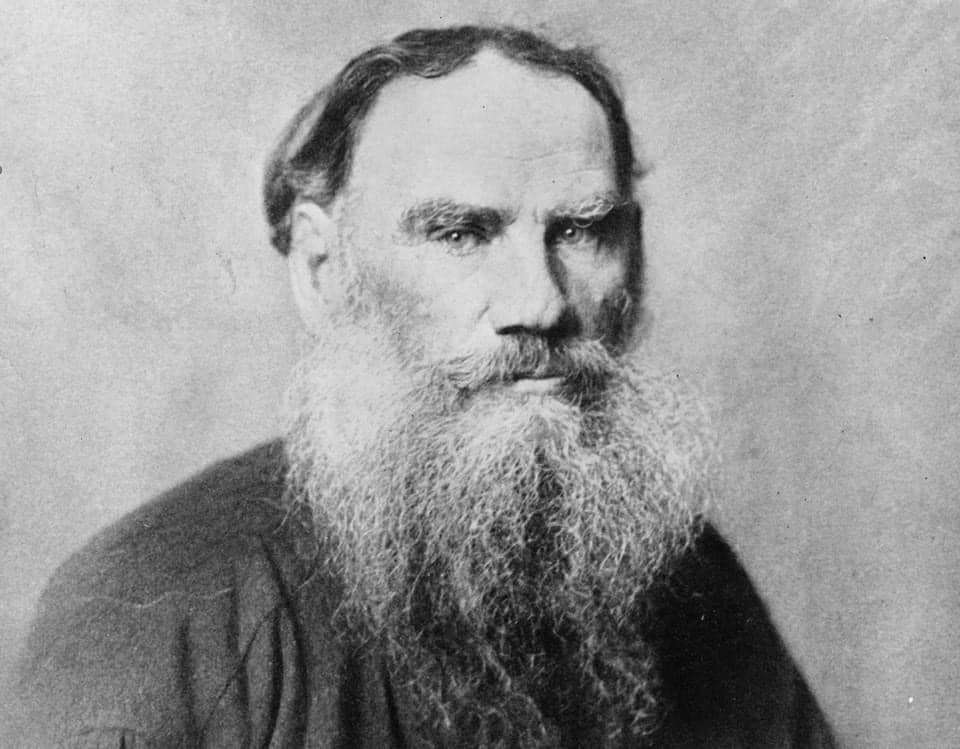
Leo Tolstoy

“Only to change the world
Everyone is thinking
To change yourself first
No one thinks.”

Leo Tolstoy

Loading

Categories
Daily Post English

. Morning sermon (Katha).

. If you aim at the common good, do not lose compassion.
. Be selfless.
. If you want peace, live with life.
. Don’t forget yourself.
. Rejoice in the good of others.
. Jealousy Don’t be short-tempered.
. Take action that does not limit others.
. Don’t mask the common good.
. Be right in the direction of consciousness.
. Do not aim for happiness.
. Let him make no pretense of his vanity, and let him be without pretense of his sin.
. bribes arising from work; public praise, popularity Don’t be cynical about history.
. Always full of courage.

Taung Kalay Sayartaw
21-09-2018.

( Google လိုင်းပေါ်မှ ဘာသာပြန်ဆိုပေးမှုအတိုင်းသာ တင်ပြခြင်း ဖြစ်သည်။)
(Translated by Google Translate without alterations)

Loading

Categories
Daily Post English

. The story of the child and the tree.

. That sunny day
The sky is blue
All the world is quiet
When it’s natural
A tree that shows the divine process.

. He has
The sound
Aesthetic
Passion
Pride
Without the laws of ignorance
Spirit (no life)
A little circle.

. However
Because he doesn’t have those laws
It is a beautiful prayer for the world
I think so.

. Let’s say
Human ego
He has a human ego
Pride
It is true that there are no egos.

. But
Spiritual
To be a figure
Does not fail
Disintegrate
The sun still shows.

. today
For today
Tree O Canyon
He also lost his life
He has a beautiful ego
If it has consequences for the world
He is me
who
There is always a story
Ego tree?
Pride tree?
About him and his story
Today is the tree canyon
His story.

Taung ka Lay Sayataw (Aeè Koe ) Acting USA
William Township. 17. September 2017

( Google ကနေတစ်ဆင့် ဘာသာပြန်ယူထားခြင်းဖြစ်သည် )
( Translated by Google Translate)

Loading

Categories
Daily Post English Politics

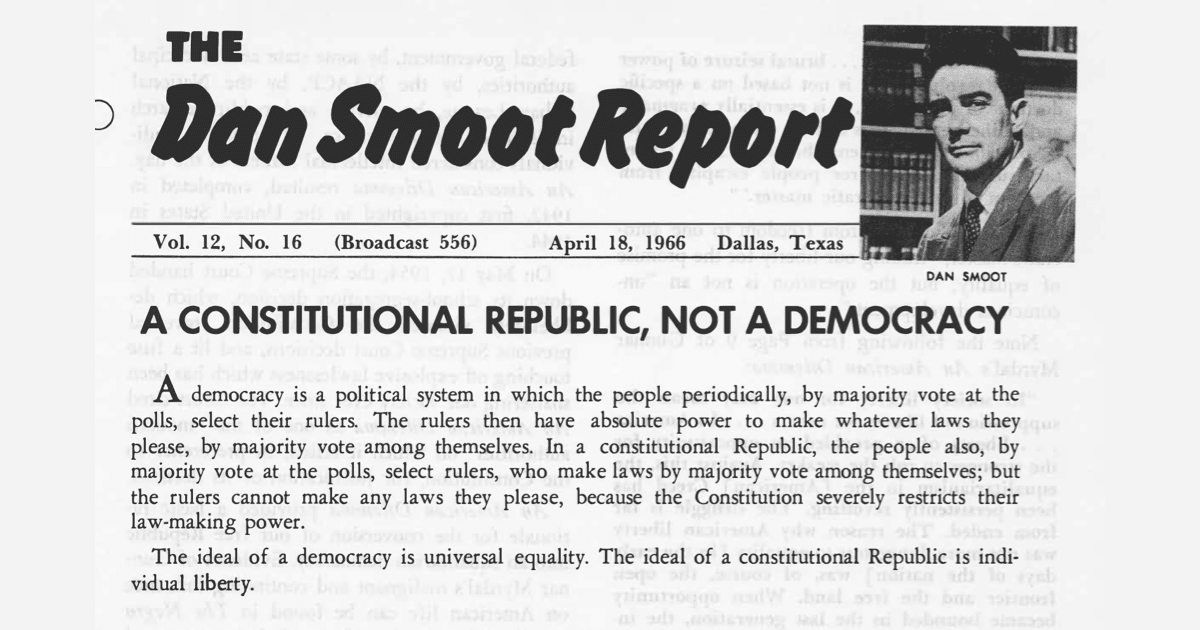
A CONSTITUTIONAL REPUBLIC, NOT A DEMOCRACY

Vol. 12, No. 16 (Broadcast 556) April 18, 1966 Dallas, Texas

A democracy is a political system in which the people periodically, by majority vote at the polls, select their rulers. The rulers then have absolute power to make whatever laws they please, by majority vote among themselves. In a constitutional Republic, the people also, by majority vote at the polls, select rulers, who make laws by majority vote among themselves; but the rulers cannot make any laws they please, because the Constitution severely restricts their law-making power.

The ideal of a democracy is universal equality. The ideal of a constitutional Republic is individual liberty.

Subversion of Language

In this century, great strides have been made toward the goal of subverting our Republic and transforming it into a democracy. One tactic of the subverters is subversion of language. By calling the United States a democracy until people thoughtlessly accept and use the term, totalitarians have obscured the real meaning of our principles of government.

Note the following passages from an article written by C. L. Sulzberger and distributed by the New York Times News Service (March 3, 1966 ) :

“Not only in the United States but in other leading democracies, recent years have seen perceptible growth in executive authority . . . .

“Amaury de Riencourt, a French intellectual, contends in his book, The Coming Caesars, that ‘as society becomes more equalitarian, it tends increasingly to concentrate absolute power in the hands of one single man.’ . . .

” ‘Caesarism is not …. brutal seizure of power through revolution. It is not based on a specific doctrine or philosophy. It is essentially pragmatic and untheoretical. It is a slow, often century-old, unconscious development that ends in a voluntary surrender of a free people escaping from freedom to one autocratic master.’ “

We are “escaping from freedom to one autocratic master,” trading our liberty for the promise of equality; but the operation is not an “unconscious development.”

Note the following from Page 9 of Gunnar Myrdal’s An American Dilemma :

“In society liberty for one may mean the suppression of liberty for others … . In America . . . liberty often provided an opportunity for the stronger to rob the weaker. Against this, the equalitarianism in the [ American] Creed has been persistently revolting. The struggle is far from ended. The reason why American liberty was not more dangerous to equality [ in the early days of the nation] was, of course, the open frontier and the free land. When opportunity became bounded in the last generation, the inherent conflict between equality and liberty flared up. Equality is slowly winning “

And the following from page 13:

” [ In] America . . . . conservatism . . . has, to a great extent, been perverted into a nearly fetishistic cult of the Constitution. This is unfortunate since the 1 50-year-old Constitution is in many respects impractical and ill-suited for modern conditions and since, furthermore, the drafters of the document made it technically difficult to change even if there were no popular feeling against change.

“The worship of the Constitution also is a most flagrant violation of the American Creed . . . . Modern historical studies of how the Constitution came to be as it is reveal that the Constitutional Convention was nearly a plot against the common people.”

Gunnar Myrdal, a Swedish socialist, was hired by the Carnegie Corporation of New York in 1 937 to direct a study of the Negro in the United States. Myrdal arrived in this country in September, 1938, engaged a large staff (some of them communists and pro-communists), and began his work. He was aided by several branches of the federal government, by some state and municipal authorities, by the NAACP, by the National Urban League, by private and public research institutions, by universities, by numerous individuals considered intellectual leaders of the day. An American Dilemma resulted, completed in 1942, first copyrighted in the United States in 1944.

On May 17, 1954, the Supreme Court handed down its school-segregation decision, which deliberately violated the Constitution, reversed previous Supreme Court decisions, and lit a fuse touching off explosive lawlessness which has been shattering our society ever since. The Court cited An American Dilemma as one of the “modern authorities” on which it relied, in preference to the Constitution, for justification of its decision.

An American Dilemma provided a basic rationale for the conversion of our free Republic into an equalitarian democracy. Evidence of Gunnar Myrdal’s malignant and continuing influence on American life can be found in The Negro Family: The Case For National Action, prepared and published in March, 1965, by the Office of Policy Planning and Research, United States Department of Labor. This government study repeats Myrdal’s thesis that liberty and equality are incompatible, holding that equality must be our national goal. Note these passages from Pages 2 and 3:

“Liberty and Equality are the twin ideals of American democracy. But they are not the same thing …. nor … are they always compatible ….

“By and large, liberty has been the ideal with the higher social prestige in America. It has been the middle class aspiration, par excellence. (Note the assertions of the conservative right that ours is a republic, not a democracy.) Equality, on the other hand, has en joyed tolerance more than acceptance. Yet it has roots deep in Western civilization and is at least coeval with, if not prior to, liberty in the history of Western political thought.”

The Big Lie

Note that the government book unequivocally labels America a democracy, characterizing as merely an assertion the truth that America is a Republic.

Here again, we see the influence of the Swedish socialist, Gunnar Myrdal. Myrdal contends that the American Declaration of Independence ( 1776) proclaimed the ideal of an equalitarian democracy (because it contains the phrase, “All men are created equal”). Eleven years later ( 1787 ) , the Constitutional Convention produced the Constitution which created, not a democracy founded on the ideal of equality, but a Republic founded on the ideal of liberty. This is why Myrdal says the “Constitutional Convention was nearly a plot against the common people.” But he and those who parrot his ideas are either ignorant or dishonest.

The Declaration’s phrase, all men are created equal, means that men are equal before the Creator, regardless of their inequality in human society. The Declaration says that men are endowed with unalienable rights and that the purpose of government is to secure these rights. The unalienable rights of man enumerated in the Declaration of Independence do not include equality, but they do include liberty, along with life and pursuit of happiness.

Equality of all men in the eyes of God and before the law is a condition essential to freedom; but no other kind of equality is possible. Government efforts to achieve material equality will produce crushing tyranny, but will not make people equal.

The Great Truth

The continuity of ideals from the Declaration of Independence to the Constitution is clear to serious students of American history. The fact that Madison, known as father of the Constitution, was a disciple and lifelong friend of Jefferson, author of the Declaration, should be enough to squelch the assertion that there is conflict of principles in these two documents. The Constitution was ordained in 1787 specifically to safeguard the principles of liberty proclaimed by the Declaration of Independence in 1776.

The writers of the Constitution were anxious to safeguard liberty against dictatorship (monarchy, they called it) ; but their chief anxiety was to protect the country against democracy.

Edmund Randolph, delegate to the Constitutional Convention from Virginia, said the “general object” of the Convention was to “provide a cure for the evils” which beset the country, claiming that “in tracing these evils to the origin,” every man had found them to be in the “turbulence and follies of democracy.” He urged the Convention to produce a means to “check … and to restrain, if possible, the fury of Democracy.”

Elbridge Gerry and Roger Sherman, delegates from Massachusetts and Connecticut, urged the Constitutional Convention to create a system which would eliminate “the evils we experience,” saying that those ” evils . . . flow from the excess of democracy.”

Alexander Hamilton, delegate from New York, said :

“We are now forming a republican government. Real liberty is neither found in despotism nor the extremes of democracy, but in moderate governments . . . . if we incline too much to democracy, we shall soon shoot into a monarchy.”

John Adams (not a delegate to the Constitutional Convention, but one of the giants of the American revolutionary period) said:

” … democracy will envy all, contend with all, endeavor to pull down all; and when by chance it happens to get the upper hand for a short time, it will be revengeful, bloody, and cruel ….

Speaking of “pure democracies” (in which the people, by majority vote, act as their own lawmakers, instead of electing representatives to make laws) , James Madison said:

” … such democracies have ever been … incompatible with personal security or the rights of property . . . .

“A republic, by which I mean a government in which the scheme of representation takes place, opens a different prospect, and promises the cure for which we are seeking . . . .”

Madison did not, however, think the “scheme of representation” was enough to protect the people from tyranny. He knew, and said, that “enlightened men will not always be at the helm” of government to serve as “proper guardians of the public weal.” He knew that unlimited political power cannot safely be entrusted to the nation’s elected representatives, to use as a majority of them see fit, because, he said, a majority of a group of men is far more likely to be tyrannical than one man is.

In a democracy, if a majority should develop hatred for all blue-eyed babies and order them eliminated, the babies could be legally executed, because whatever a majority wants, at any given moment, is supreme law of the land, in a democracy.

Our Constitutional System

How can liberty be safeguarded against the mindless, soulless tyranny of majority rule, when government is founded on the principle of majority rule – when the men who govern, elected by majority vote of the people, make laws by majority vote among themselves? Jefferson answered the question succinctly:

“In questions of power . . . let no more be heard of confidence in man, but bind him down from mischief by the chains of the Constitution.”

In short, America was founded not as a democracy but as a constitutional Republic. We pledge allegiance to the Republic for which our flag stands, not to a democracy. The Constitution requires a “republican form of government” for all states, but does not mention democracy, and neither does the Declaration of Independence or the Bill of Rights.

The Constitution is a binding contract, specifically enumerating limited powers which the federal government can legally exercise, prohibiting it from exercising any powers not granted in the contract. It denies federal officials the power to do whatever they claim to be necessary for the general welfare. Federal action not clearly authorized by the Constitution is illegal even if approved by an overwhelming majority of the people, because all the elastic powers of government are left with the states.

Ultimate power to change the organic structure of government was left with the people; but the means of making changes (amending the Constitution) were carefully prescribed to militate against hasty, unwise decisions by the people.

As Benjamin Franklin left the State House in Philadelphia on the closing day of the Constitutional Convention, a woman asked him what kind of government the Convention had given America. Franklin replied:

“A Republic, if you can keep it.”

Benjamin Franklin

Very old and very wise, Franklin saw through the mists of time to the day when Americans might trade their freedom in a constitutional Republic for the promise of government-guaranteed equality and security in a democracy – and beyond that, to the day when democracy inevitably degenerates into dictatorship, guaranteeing nothing but poverty and serfdom for the people it robs and rules.

The American constitutional system, unique in history, enabled Americans to develop a backward continent into the most magnificent nation of all time. The system was designed to prevent both tyranny by government and reckless rebellion by the people. We must restore it and keep it.

SUGGESTION: Distribute copies of this Report to students, teachers, libraries – and to anyone who calls the United States a democracy.

THE DAN SMOOT REPORT is published weekly by The Dan Smoot Report, Inc., Box 9538, Dallas, Texas 75214 (office at 6441 Gaston Ave.). Subscriptions: $18.00 for 2 years; $10.00, 1 year; $6.00, 6 months; first class, $12.50 a year; airmail, $14.50. Dan Smoot was born in Missouri, reared in Texas. With BA and MA degrees from SMU ( 1938 and 1940), he joined the Harvard faculty ( 1941) as a Teaching Fellow, doing graduate work in American civilization. From 1942 to 1951, he was an FBI agent; from 1951 to 1955, a commentator on national radio and television. In 1955, he started his present independent, free-enterprise business: publishing this REPORT and abbreviating it each week for radio and TV broadcasts available for commercial sponsorship by business firms.

Copyright by Dan Smoot, 1966. Second Class mail privilege authorized at Dallas, Texas No Reproduaioo5 Pennitted.

The Dan Smoot Report The true form of the US Government is a Republic, Not A Democracy. Not merely a symantic difference. The Founding Fathers despised democracy. They formed a Republic to guard against rule by majority. First we were told we were a democracy, then the republic was transformed into a democracy. Now we are witnessing the democracy collapse into dictatorship.

Sources:

Dan Smoot Report #556 (A Republic, Not A Democracy)

Dan Smoot Report Resource Page | federalexpression (wordpress.com)

The Dan Smoot Report, 1966: “A Constitutional Republic, Not a Democracy” – The American Minervan (theamericanminvra.com)

Loading